In a world where everything is subjective and polarizing opinions are the norm, where anti-fans and trolls take ‘love to hate’ a little too far, and where any story popular enough to become a pop-culture phenomenon is almost guaranteed to have a small-but-vocal minority that can’t see what all the fuss is about, I have never once seen, read, or heard of anyone say that Fullmetal Alchemist is a bad story.
None.
I’m sure they exist, but during the course of its run Fullmetal Alchemist reached the rarefied air of being almost universally beloved within the manga/anime community and being critically acclaimed as a damn good story. This success is wholly deserved. Arakawa was able to do something that a lot of shonen mangaka can’t, and as a result Fullmetal Alchemist is one of the best plotted, tightly written manga I have ever read.
Others have and will write about the philosophy Arakawa presents, point out the incredible amount of research she was able to cram into her series, extrapolate on the world building better than I could, but today I want to talk about something I’ve not seen anyone else touch on, and that’s how she integrates her themes into her characterization in order to really drive the point she’s trying to make home.
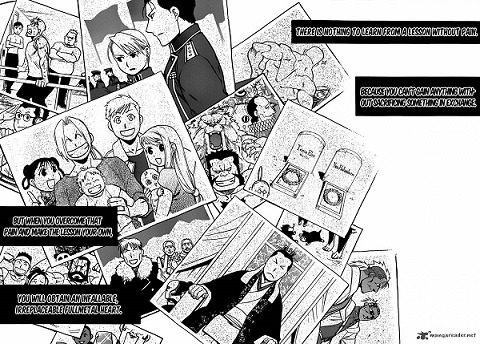
So what’s the main theme of Fullmetal Alchemist? Luckily Arakawa tells us directly on the next to last page of the series.
There’s no such thing as a painless lesson, they just don’t exist. Sacrifices are necessary. You can’t gain anything without losing something first. Although if you can endure that pain and walk away from it, you’ll find that you now have a heart strong enough to overcome any obstacle. Yeah… a heart made f u l l m e t a l.
Fuse those two men together and you get the epitome of manliness
oh sure, fuse those two together and you get “a paragon of masculinity and justice”, but when I fuse my daughter and my dog suddenly it’s “incredibly illegal” and “spitting in the eyes of God”




 heget's WordPress