Since childhood, Ariel has been among my favorite Disney princesses. I connect with her deeply – and whenever someone (like Keira Knightley recently) brings up the old line that she is a ‘bad role model’ for young girls because she ‘gives up her voice for a man,’ my heart breaks.
That reading of Ariel’s character is reductive and inaccurate.
Everyone always mentions that Ariel was interested in the human world before meeting Eric, but not as many people point out how radical that makes her in the context of her own society.
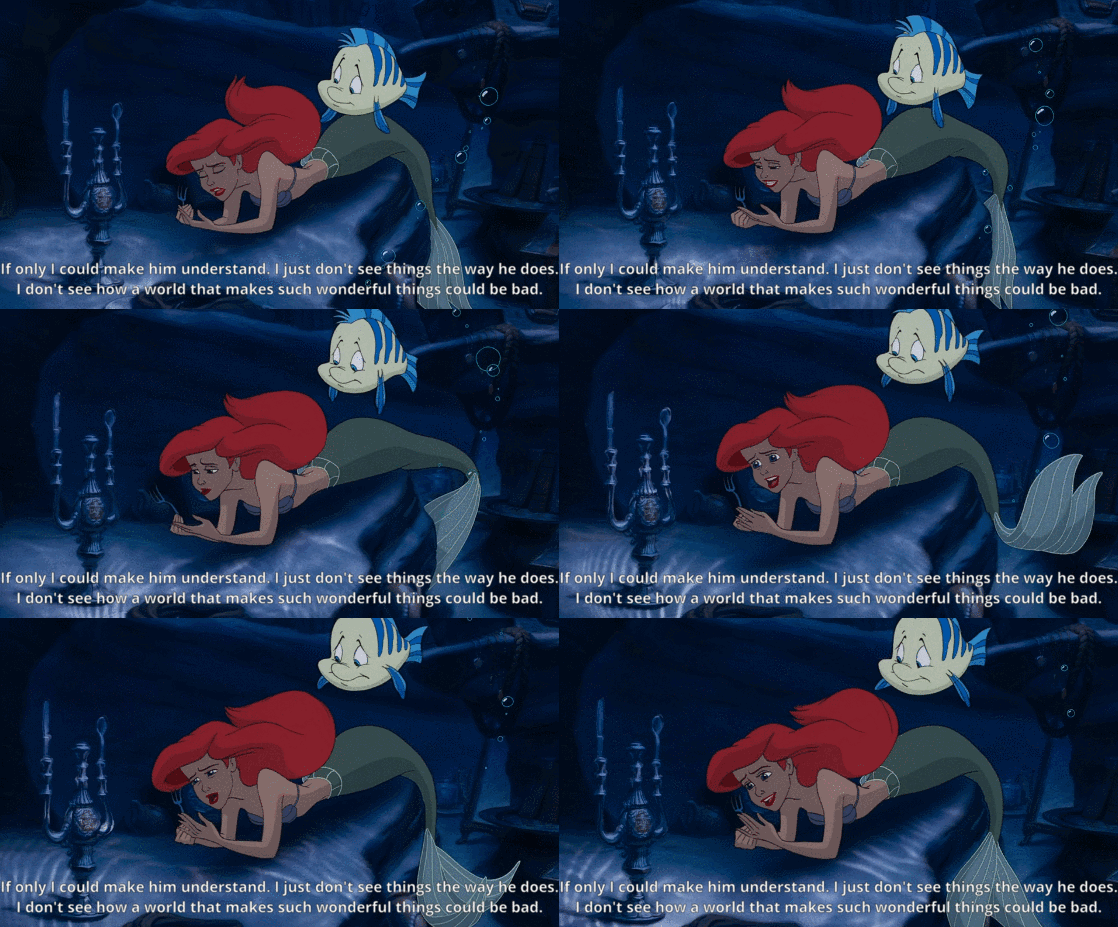
Ariel lives in a society that is xenophobic towards humans, Triton at various points calls them “barbarians,” “savage,” and “incapable of any real feeling.” She lives in a society that constantly tells her that her interest in the human world is wrong and bad, something she struggles with at the start of Part of Your World:
By seeking a fuller understanding of the human world, Ariel actively challenges her father’s xenophobia, thinking for herself instead of accepting her society’s fears and prejudices.
The film goes out of its way to establish Ariel as an outsider within her own society. Think for a moment about the opening lines of Part of Your World:
Look at this stuff. Isn’t it neat? Wouldn’t you think my collection’s complete? Wouldn’t you think I’m the girl The girl who has everything? Look at this trove, Treasures untold How many wonders can one cavern hold? Lookin’ around here you’d think Sure, she’s got everything…
People who criticize Ariel so often mis-characterize her as simply a spoiled teenager. The very statement, “She gave up her voice for a man!” implies she’s a foolish girl who throws her life and agency away in a fit of pique.
Yet, the opening of Part of Your Worldanticipates that certain members of the audience will have a superficial understanding of Ariel’s pain and directly addresses that. On a superficial level, Ariel does seem like “the girl who has everything.” She is the daughter of the most important merman in Atlantica, she has countless treasures hidden away in her grotto…
But that’s the thing, you see. They’re hidden in her grotto. Ariel may be the daughter of the sea-king, but the sea-king hates and fears humanity. Part of Your World is the most heartbreaking rebuttal to anyone who sees Ariel as a shallow teenager because it shows how alone she truly is. Except for Flounder, she has no one under the sea she can genuinely confide in. (She confides in Sebastian, of course, but he was sent by her father to spy on her and he does betray her trust
– by mistake, but he does). Her sisters and the rest of Atlantica presumably do not question the prejudices that cause the human world to be forbidden to the sea folk.
Ariel is an outcast, forced to hide who she is from the people who should love her unconditionally.
The more Part of Your World goes on, the more devastating and resonant Ariel’s collection of artifacts becomes.
These artifacts represent a void in her life and, at the same time, are the only means she has of filling that void.
She longs to have knowledge, but her society imposes ignorance on her. She longs to see the human world herself, to ask questions and finally be answered – but it is all denied her. The imposed ignorance forces her to live vicariously through the artifacts she collects.
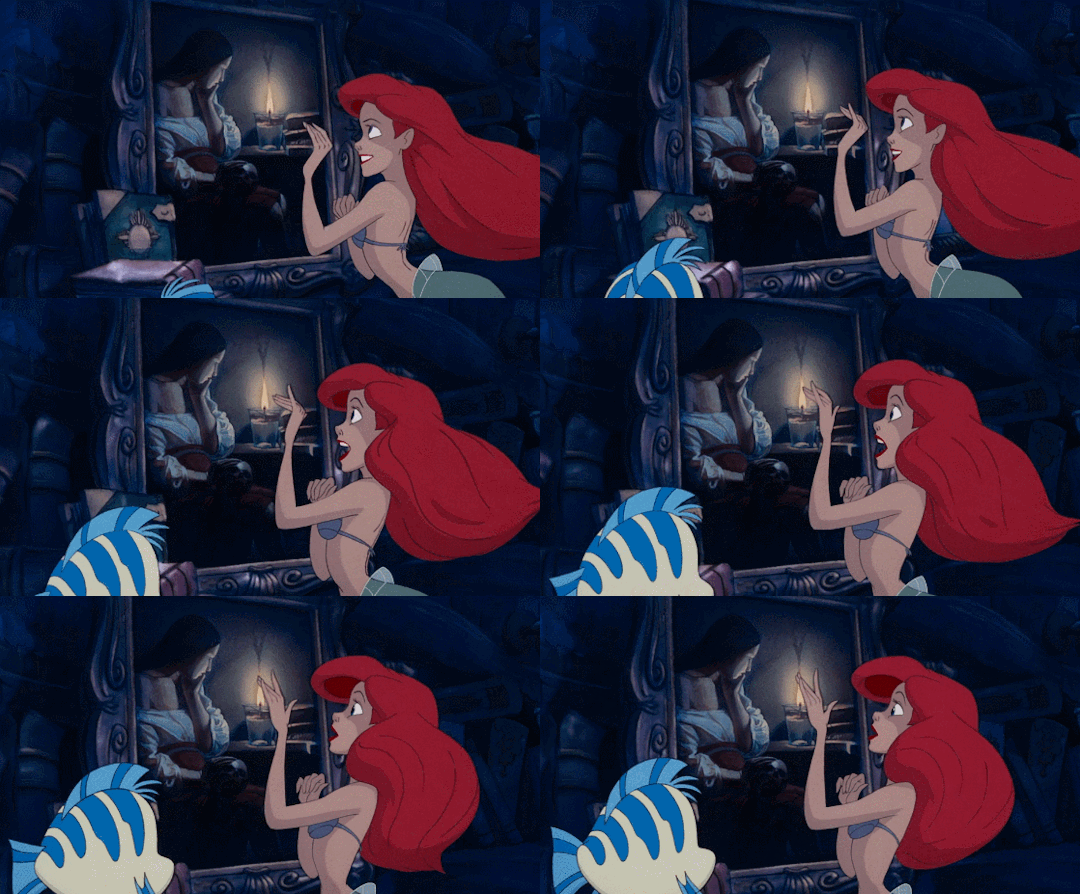
She cannot see a couple dancing, so she must content herself with a music box.
She can only experience the shadow of fire on oil and canvas.
Her collection perpetually reminds her that there is a world beyond her reach. At the same time, it is her central way of interacting with that world. Yes, she can go up to to the surface and talk to Scuttle, but her collection is something so much more personal. These are items she saved from the ruins of ships, sometimes at the risk of her own life… so she could study them, learn from them, and lament the unjust rules of her society that prevent her from learning more…
Her courage, her curiosity, her thirst for knowledge are all bound up in these precious possessions.
And yes, they are objects. Yes, she wants more than a collection of objects. But this collection is all she has. And, as far as Ariel knows, it is all she will ever have…
When you’re all but alone in the world and you have only meager scraps to cling to, those scraps mean the world to you.
And, I remind you, Ariel cannot even openly enjoy her collection of scraps, the shadows of a world she cannot touch. She has to hide even them, guard them, keep them secret.
Ariel’s grotto is a place of solace and security where she can be herself without fear of judgment.
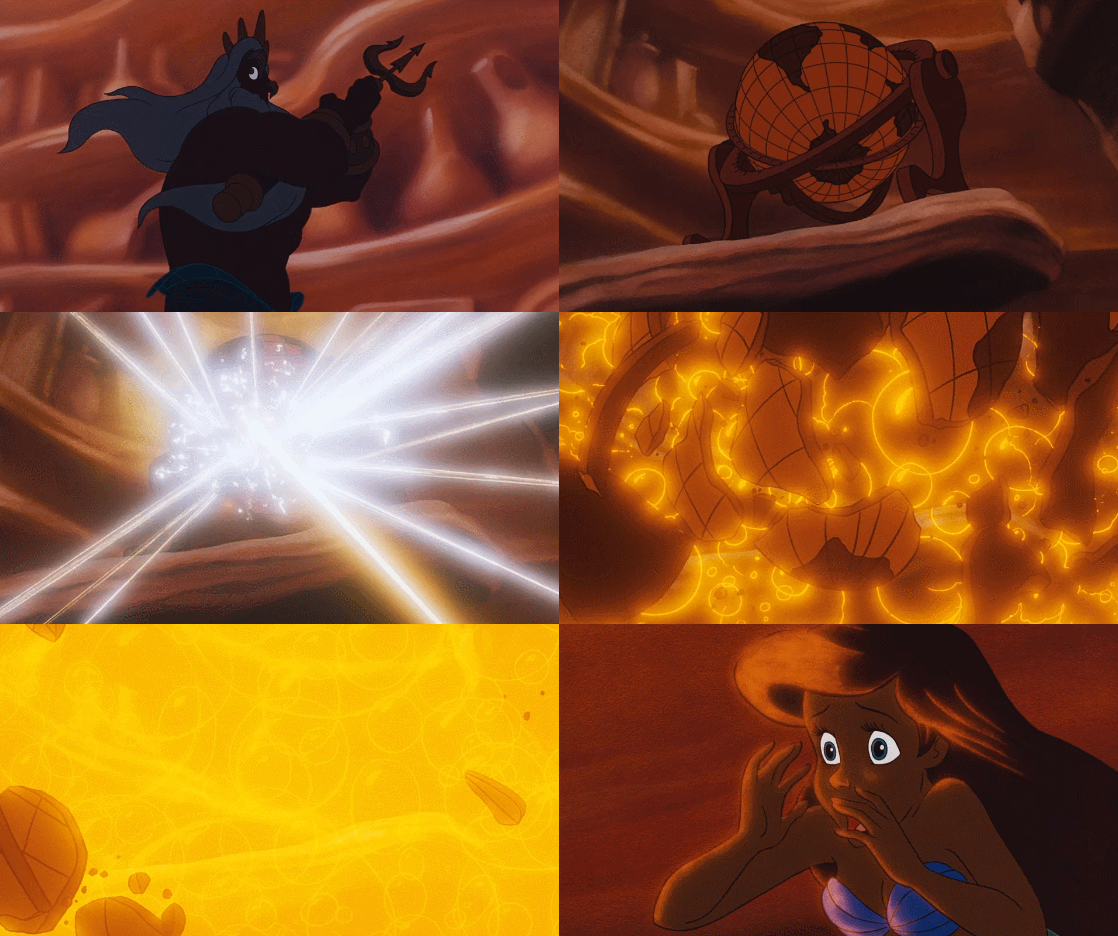
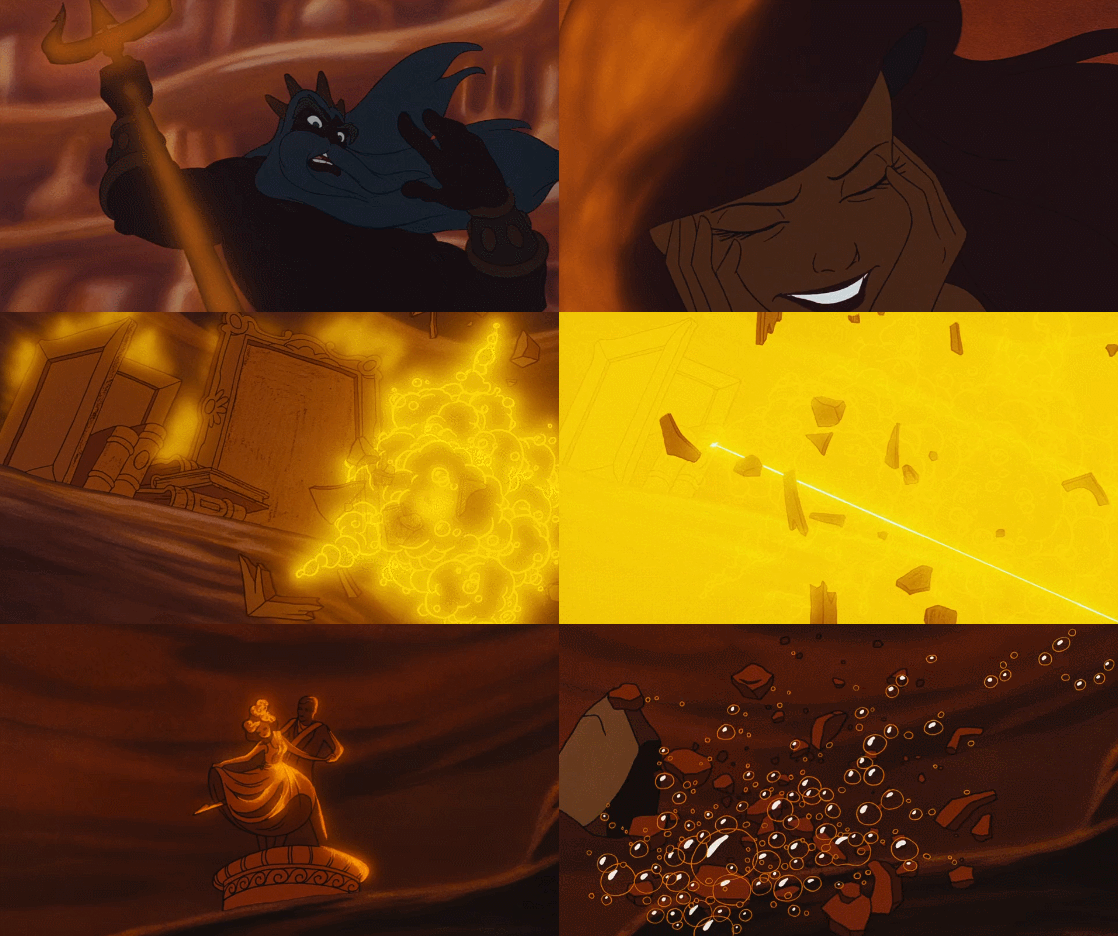
There is a reason the destruction of Ariel’s grotto harrowed me more as a child than any other scene in a Disney film. I could hardly watch it. I hid my face. I begged my family to skip scene. I was reduced to a sobbing mess. On a personal level, it harrowed me more than the destruction of Cinderella’s dress.
That reason is because, in watching the scene, I felt the pain of a place of refuge being invaded.
By the time we reach the destruction of the grotto, we are as emotionally invested in Ariel’s collection as she is because we see that the objects are more than objects. They are extensions of herself, encapsulating all her feelings of hope and hopelessness.
Destroying those items is like annihilating a part of her soul.
That is why I hate the “she gave up her voice for a man” line of thought so much. Because it so blatantly disregards the context of the film. Because it paints Ariel as a shallow teenager. Because it places blame for what follows solely on Ariel’s shoulders and absolves Triton of any wrongdoing.
I want to tread carefully here because, like Ariel, Triton is a nuanced and complex character. He has good intentions and cares about his youngest daughter.
Yet, even a well-intentioned individual can be in the wrong. Even an individual who is right about certain things (Ariel is indeed impetuous and reckless at times – though I hope my analysis reminds readers that those are not her sole character traits), can be wrong about other things.
And Triton’s confrontation with Ariel highlights his failings and his faults.
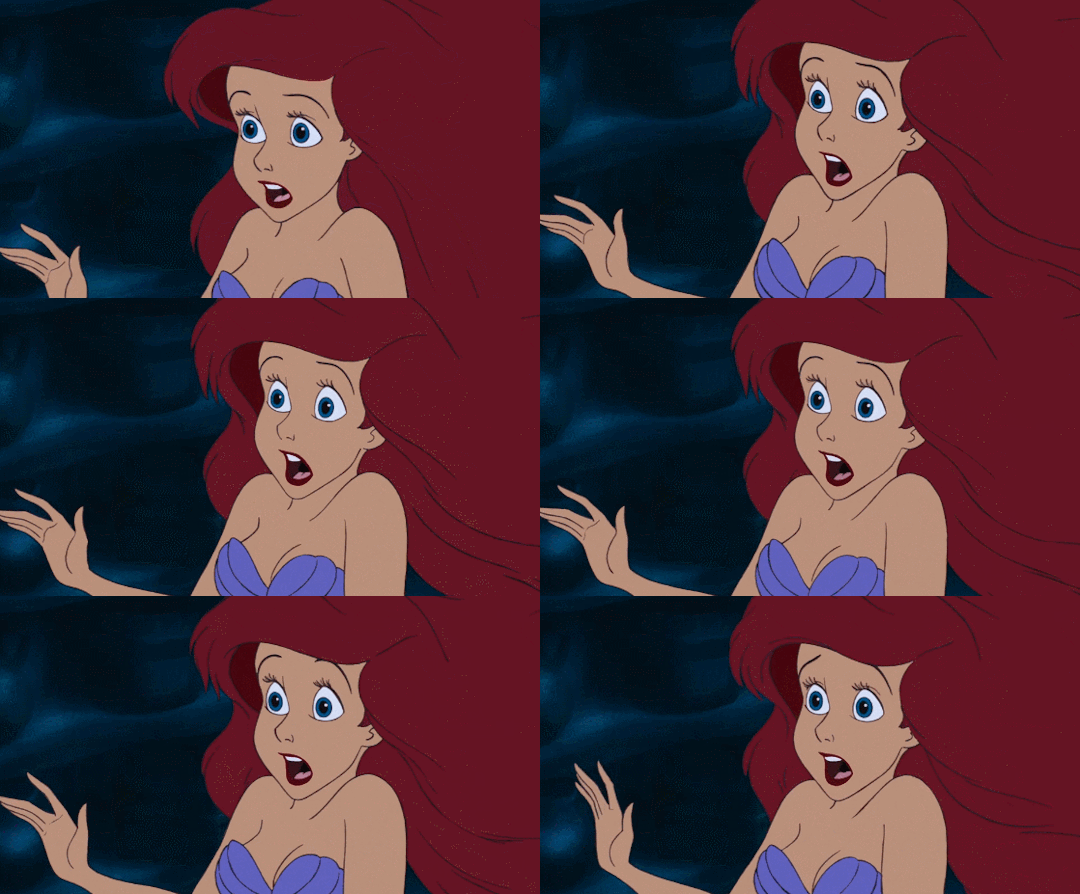
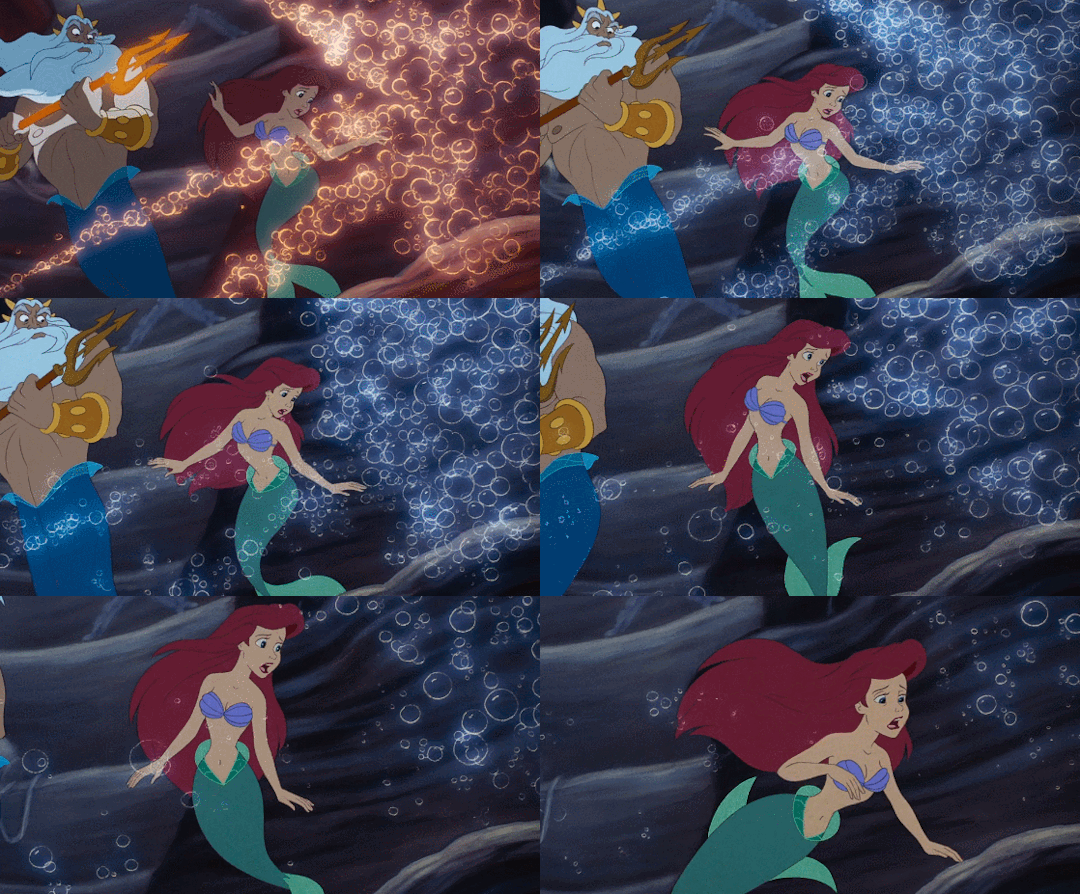
Look at Ariel’s face when she first sees her father in the grotto:
The enhancement of expression in animation allows the audience to clearly see the fear in her face.
Triton has created an environment where his own daughter is afraid of him.
No parent should do that to their child.
Confronting Ariel, Triton says, “I consider myself a reasonable merman. I set certain rules and I expect those rules to be obeyed.”
On one level, Triton is right to expect his children to respect the rules he sets in place.
What I feel Triton misses, however, is that respect is not the same as intimidation.
Since Triton wants Ariel to accept his rules based solely on his authority as her father, he makes it impossible for there to be any communication between himself and his daughter.
This dynamic means that he will not listen to Ariel even when Ariel is in the right and he is not. Children should listen to their parents, but in the same way, parents should listen to their children.
Triton may be in the right to worry about his daughter’s safety, but his fear is still born of bigotry – bigotry that Ariel recognizes and rejects.
Triton, after all, grows angry at his daughter because she wouldn’t let another living being die. He specifically calls her out because she “rescued a human from drowning.”When Ariel counters that allowing someone helpless to miserably drown is cruel, he shuts her down with:
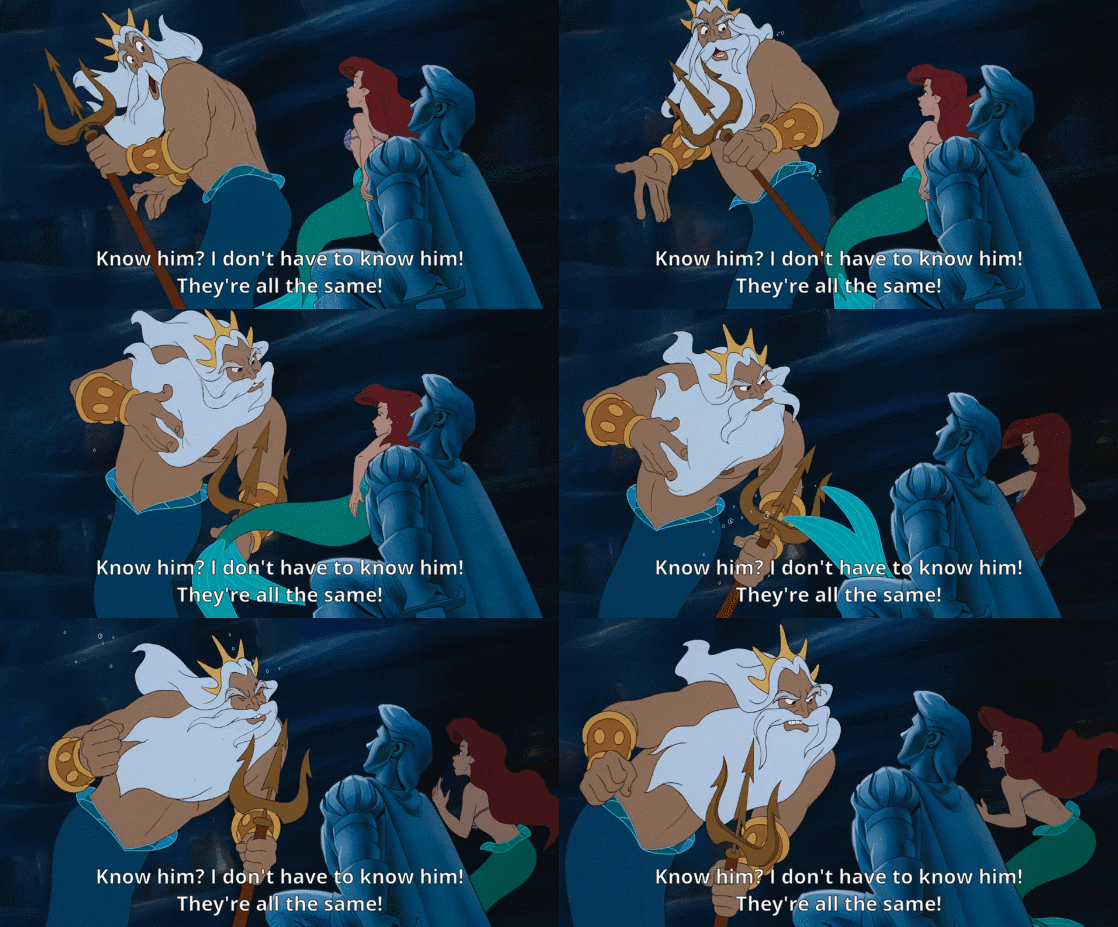
When Ariel points out the illogical nature of her father’s brutal line of thought and says, “You don’t even know him!”, Triton responds:
Even if a viewer is largely sympathetic to Triton, that viewer cannot ignore Triton’s prejudice in this moment.
He generalizes millions of people.
And if the rules he sets down include the tacit understanding, “Let innocents die because, by virtue of their humanity, their lives have no value,” then maybethose rules deserve to be broken.Maybe those rules need to be changed.
Ariel may be a teenager, but she is wiser than her father here.
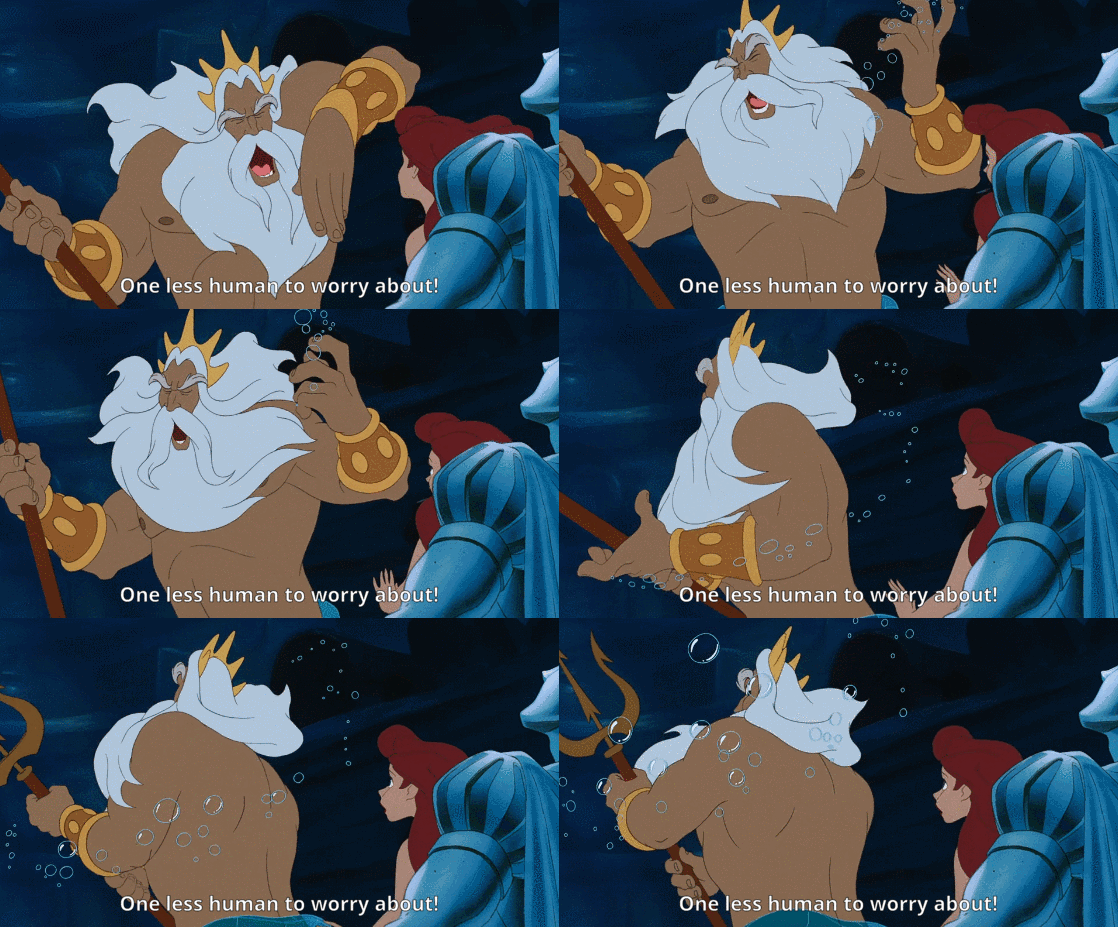
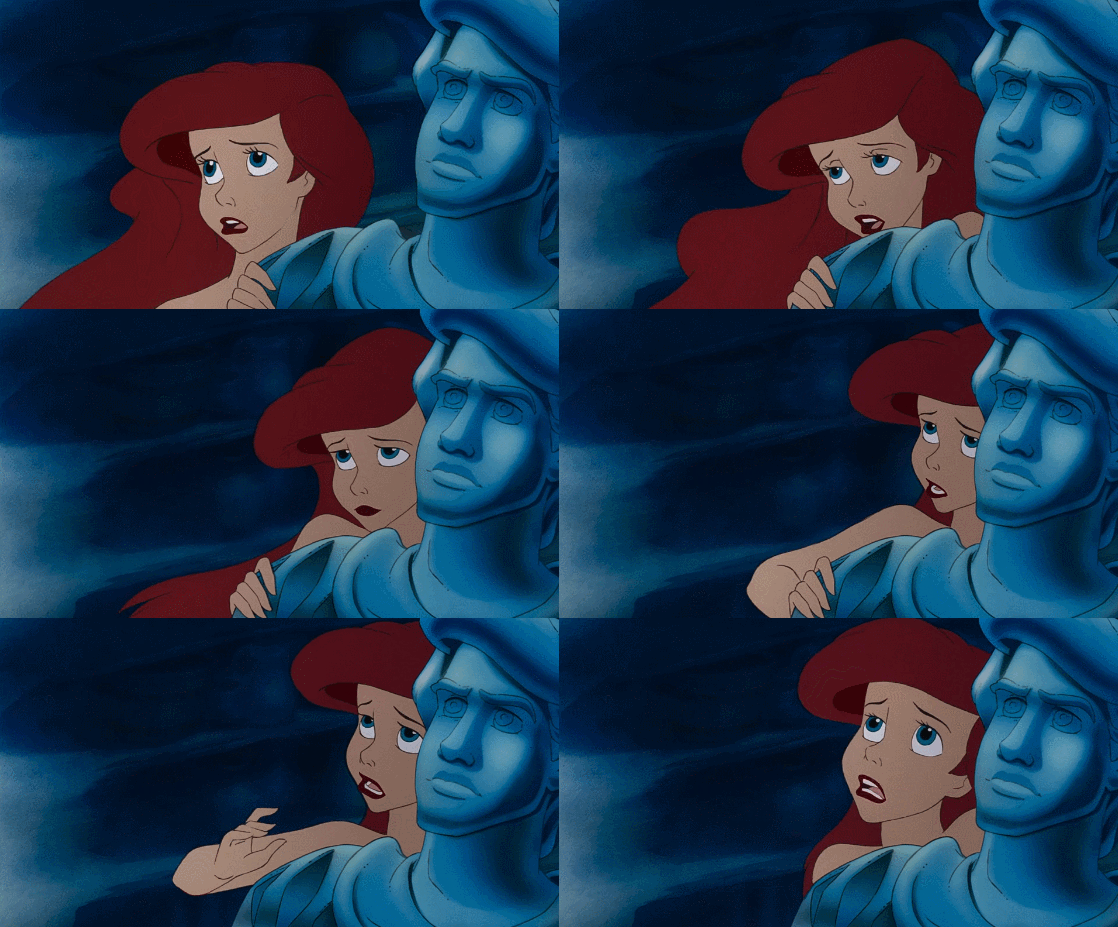
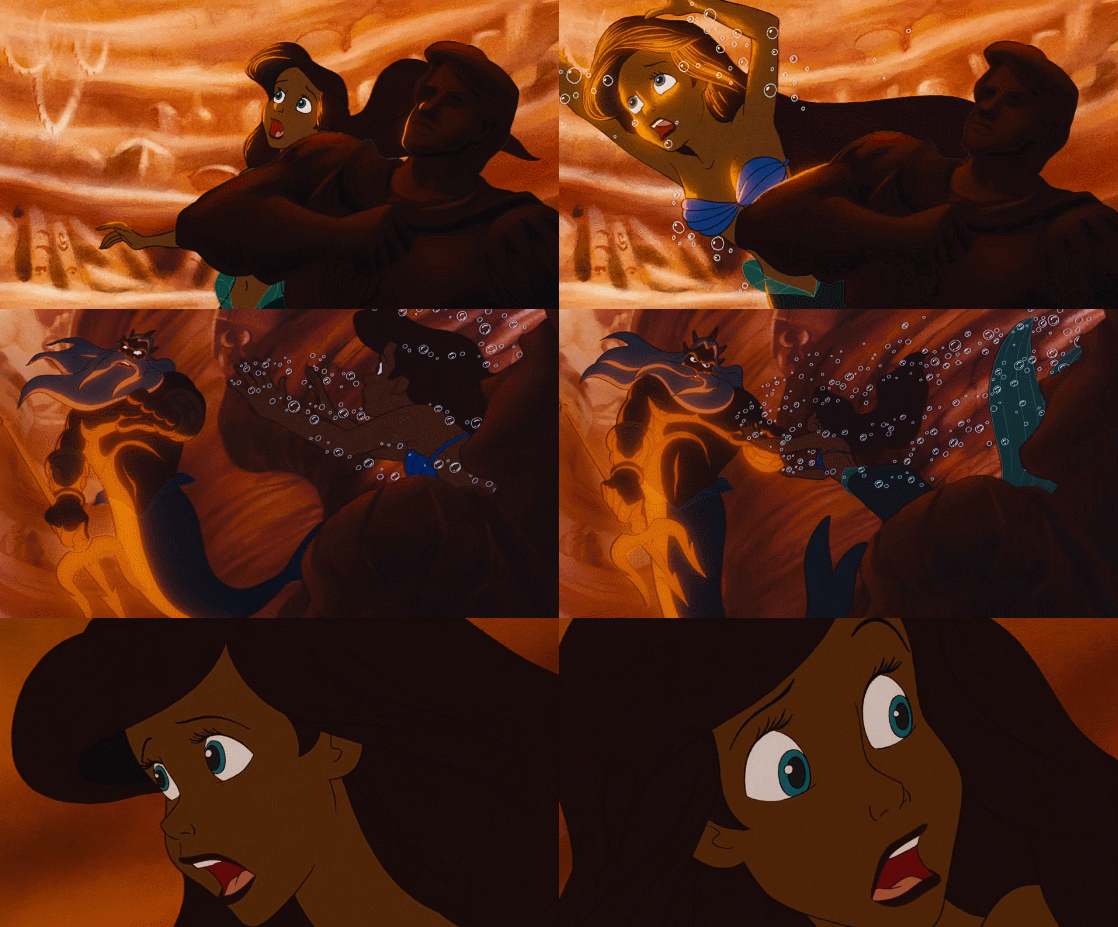
(Also, can I say that Ariel’s body language here breaks my heart every time I see it? She’s swimming away from her father, recoiling…
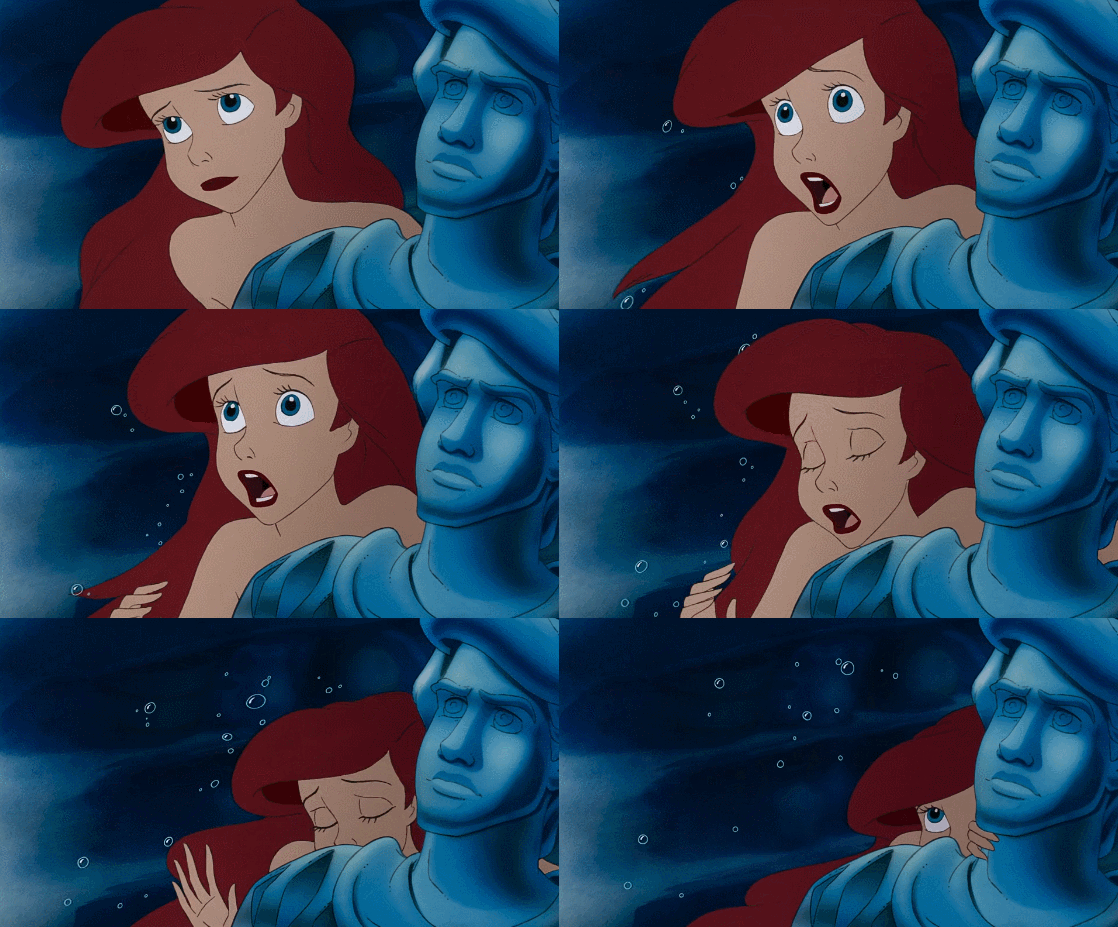
…until she’s cowering behind Eric’s statue. She looks like she’s about to cry as her father pours forth more vitriol…
…and after she bursts out with the exclamation, “Daddy, I love him!”, she’s terrified that she’s said it.)
Triton believes that he alone is in the right and destroys the grotto because he feels it is “the only way” to “get through to” his daughter. He believes he must be cruel only to be kind.
Yet, in the end…
…he only succeeds…
…in being cruel.
Triton’s unwillingness to listen to his daughter
– his unwillingness to treat her with the same respect he demands of her –
only widens the gulf between them.
Ariel does not go to the sea-witch because she has been mooning over a man.
Ariel goes to the sea-witch because she has no voice in her own home. Becoming human, she gains the ability to live life on her own terms. Becoming human, she ironically gains the voice she has been denied for so long.
Ariel goes to the sea-witch because her father sends a message to her – a message that she does not matter, that there is no place for someone like her in Atlantica.
Triton may never have meant to send that message, but send it, he did… and he should be held accountable for that.
Indeed, the film does hold him accountable for that.
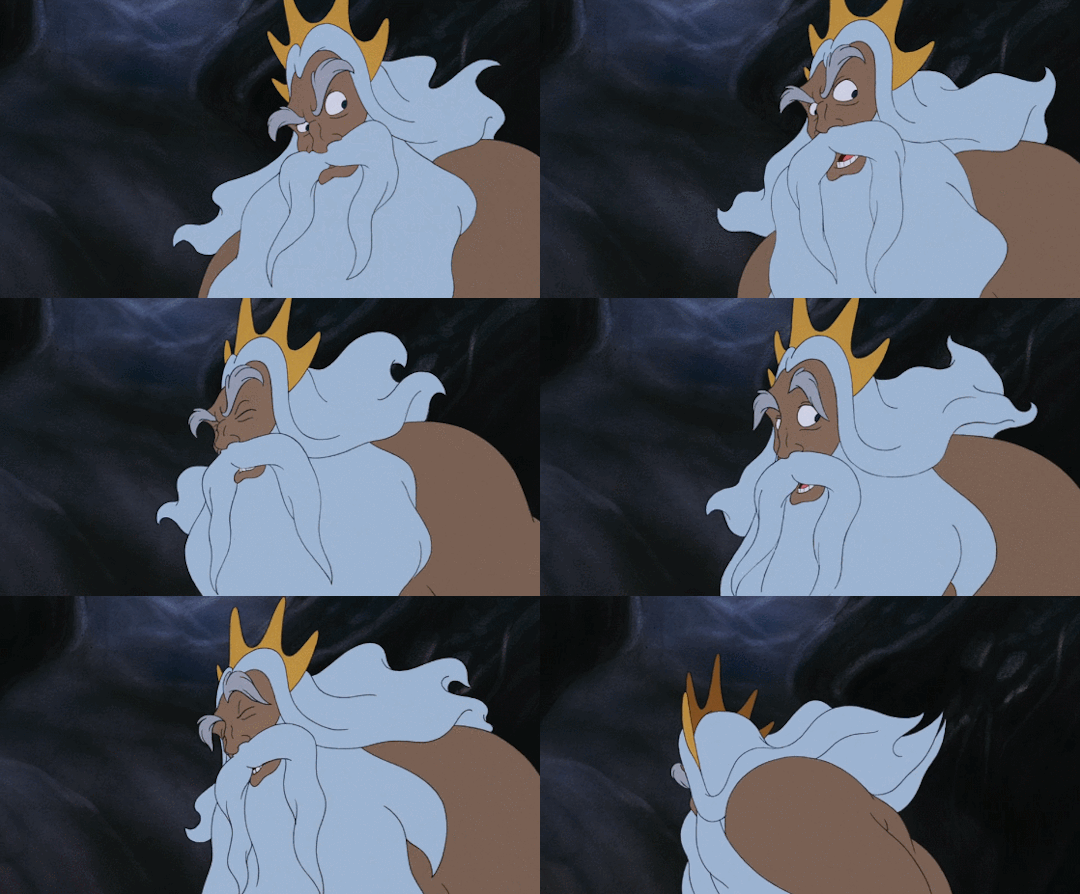
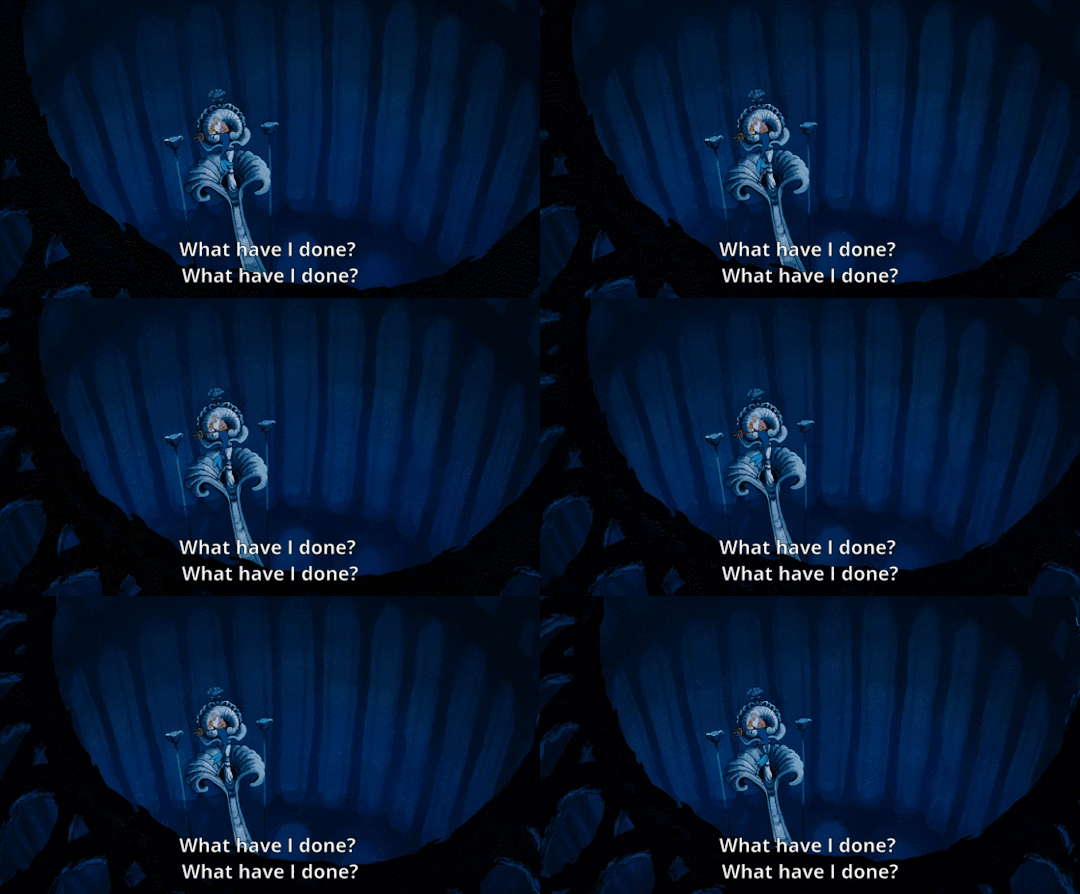
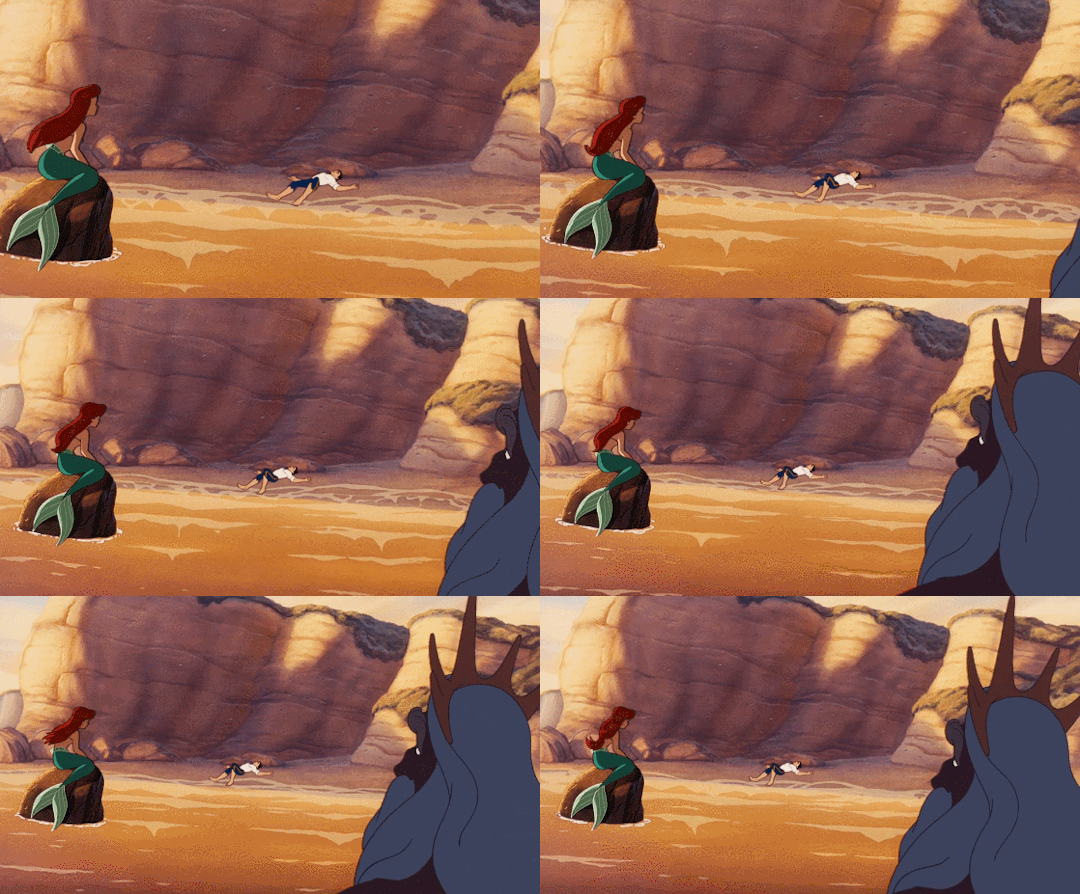
After destroying the grotto, Triton realizes he has done a horrible thing.
Look into his eyes after Ariel falls to weeping:
Look at the regret in his eyes. Look at the remorse. He knows he has gone too far. He never meant to hurt his daughter like this.
And when Ariel vanishes from Atlantica, Triton takes responsibility for his actions. What does he say when his daughter cannot be found? Does he say, “What folly has my daughter gotten herself into now?”
No. He says:
Simply saying that Ariel ‘gave up [her] voice for a man’ ignores the painful complexity of the situation in which she finds herself. It ignores the depth of her motivation. It ignores Triton’s culpability. It ignores her best character traits and only highlights her flaws (and yes, she has flaws, for she is a multifaceted, well-written character.)
But Ariel’s rejection of prejudice, her ability to see beauty in a group that nearly everyone around her demonizes, her courage and determination and love, are all venerable traits…
…and Ariel’s courage, determination, and love are what inspire Triton to open his heart and change.
Some people say that The Little Mermaid is more Triton’s story than Ariel’s. I disagree and feel that assessment unfairly dismisses Ariel’s emotional journey. Triton has a compelling arc in the film – but that arc is only set in motion because of Ariel’s agency.
He learns from his daughter’s example.
He grows because of her.
Why don’t we talk more about Ariel, the young woman who always challenged her father’s prejudice? Why don’t we talk more about Ariel, who actively spoke out about the flaws she saw in her society? Why don’t we talk more about Ariel, whose actions helped change that society for the better? Why don’t we talk more about Ariel, who formed a bridge between two worlds and enacted positive change?
Why don’t we talk more about that Ariel?
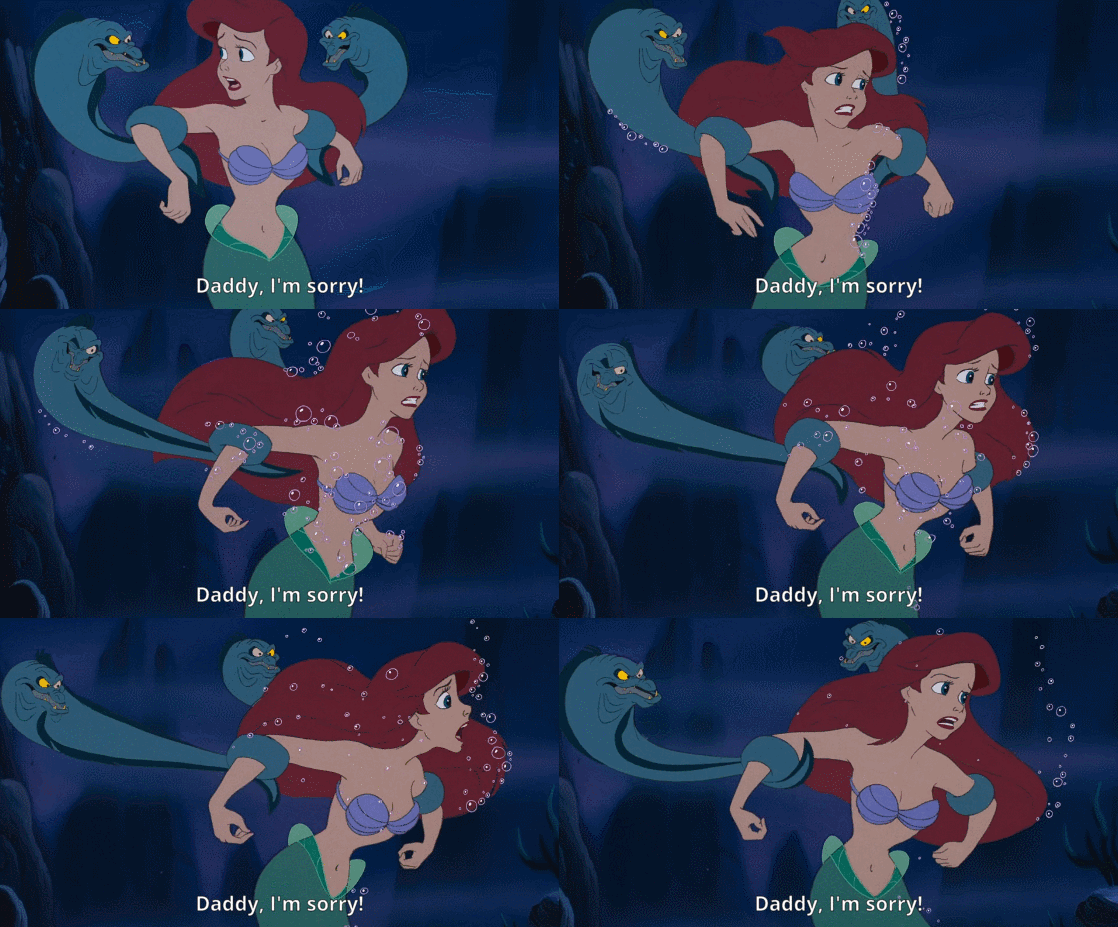
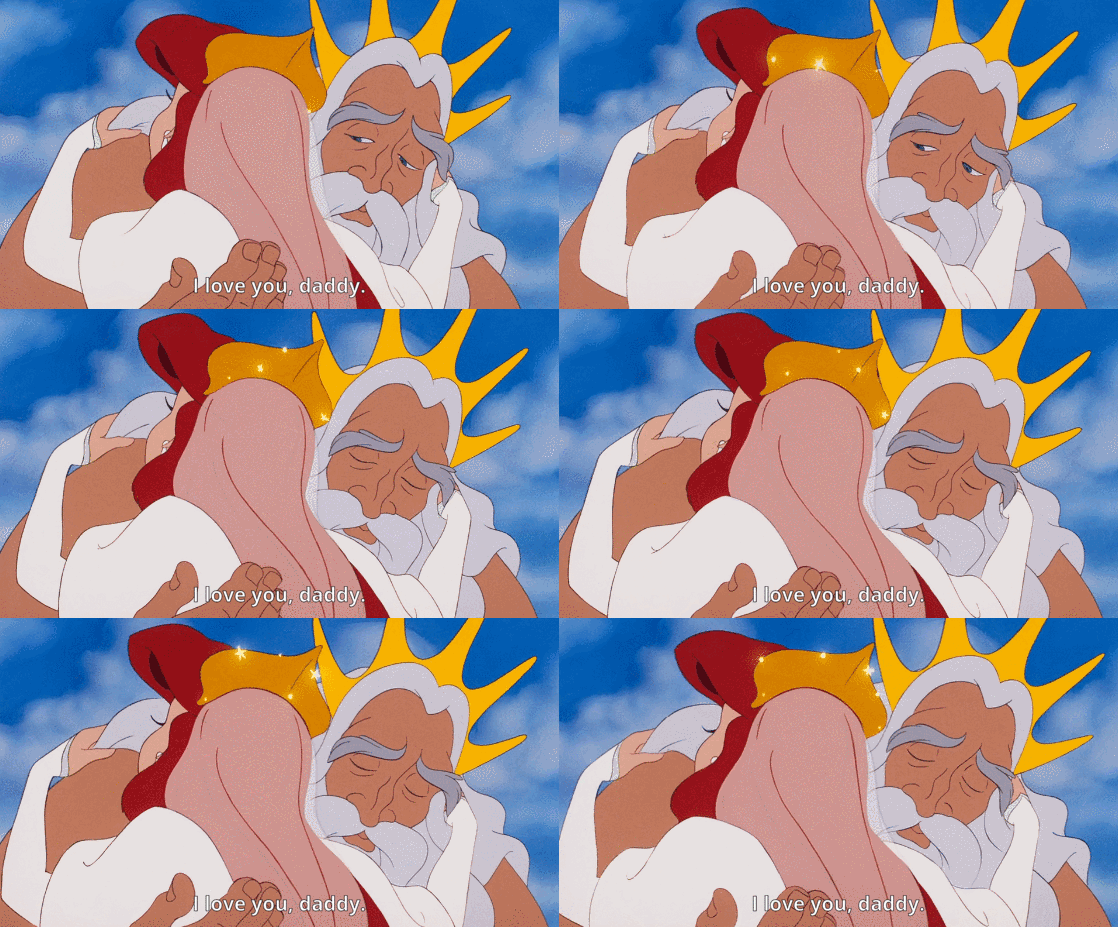
I know Ariel can be impulsive, but she is sixteen years old, and her impulsiveness only makes her character realistic. She makes mistakes but, like her father, she owns up to those mistakes and learns from them:
There are critics of Ariel’s character who want to make the story of The Little Mermaid black and white. Because Triton recognizes Ariel’s impulsiveness, they ignore Triton’s faults and trivialize Ariel.
Yet, the story the film presents is not so black and white. Ariel and Triton are not so one-dimensional.
They both learn from each other and grow together.
This embrace is so meaningful because, by the end of the film, Triton finally shows Ariel the same respect he asks of her and in so doing, he earns her respect.
Ariel, meanwhile, recognizes her own mistakes and gains a new appreciation for her father.
The Little Mermaid is a beautiful film and Ariel is a brave, inspiring, complex heroine.
I also want to point out, Howard Ashman, a gay man who died of AIDS, was a key creator in this film. He also had a key role in creating Beauty and the Beast. The films we worked on were about outcasts.
The little mermaid was a film I latched onto as a small person, though at the time I didn’t know why. As an adult my brother pointed out the destruction of the grotto and how similar in that moment triton is to our own dad. Our dad never showed remorse for his attitude though. And we feared him for it. Still do in my thirties.
the thing i think that’s getting lost, at least from shallura fans and shiro stans is like, in a lot of ways… s7′s queerbaiting is like, only it’s second biggest problem? i’m not upset about not getting canon klance, i’m not upset over allur@nce seemingly becoming canon. i’m not even upset about the bullshit backstory of earth vs how much more dramatic and emotional it would have been to have the paladins there while being attacked.
i’m upset because voltron took it’s character that is the most representation for the most amount of people in the entire show: japanese poc, a buff asian man, disabled, chronically ill, mentally ill, and lgbtq+ and were like
yeah, let’s sideline him, let’s take the role he earned and loved and fought and died for and give it to someone who never even wanted it in the first place.
and thought it was good storytelling. vld’s biggest sin has always been its incredibly shitty treatment of shiro, and this was the absolute last straw for me.
…wow. Shiro has struggles. Shiro is a person. Woah. They’re treating him like they’ve always treated him. The shock.
My gosh, that isn’t their biggest sin. The complaints about them torturing the characters are so strange, that’s how writing works. You want there to be conflict, you want the characters to suffer, you want to let the characters grow through pain. Shiro still has more of his character arc left and this is part of it.
Keith being given the Black Lion is literally?? One of those few things where they were just aligning with the old Voltron show? Keith was meant to have the Black Lion in the end.
And don’t forget about the White Lion. They’ve been trying to keep it on a down low, but Shiro channeled its power this season and used it to save earth. He isn’t meant to be the leader of voltron. But that doesn’t mean he doesn’t still have powerful things ahead of him.
Shiro is not a weak character. He isn’t a beaten down character. He’s the leader of the Atlas, the space dad, the man who’s patience enough to take in an orphaned kid and help the kid survive in a place like the Garrison. Shiro is a genuinely good character.
You can try to argue that Shiro has suffered the most out of the Paladins, but that doesn’t devalue him as a character. He’s still a strong, kind, wise person and they created him that way. My gosh, complain about the things you don’t like all you want, but this is not their biggest sin.
and here’s some more bullshit i called out when the interview saying that shiro’s bond with the black lion was gone:
“because if shiro isn’t the one true black paladin, then why wasn’t keith picked by black from the start? why was allura wrong? why was shiro able to do the eye glow in 1×02, like alfor did, before any of the other paladins even after seasons of development with their lions? why have shiro’s arc of a full 26 episodes be about his leadership and bond with the black lion, when keith got maybe 7 episodes at best? why always show keith piloting black through his bond with shiro instead of bonding with the lion itself? why have shiro be the one to fight and earn black’s trust in the astral plane? why have s6 prove that keith was only picked by black because shiro wanted him to be?why already have a plotline of ‘shiro’ being the strategic director and showing him missing black? why have keith not be in black and instead have an entirely separate arc instead of proper development? why have keith unlock things that shiro was able to unlock by himself that keith needed shiro’s help to do? why have all the lions, including black, roar the way they did in the pilot only when shiro returned? why have such a heavy emphasis on shiro wanting to be a paladin if he wasn’t going to be one again? why have a main character, the closest thing vld has to a main character every season, suddenly be sidelined?why have shiro literally fulfil the role of the black paladin more or less from beyond the grave and in the voltron void for four goddamn seasons?why have shiro being in the black lion’s astral plane, because she refused to let him die, to have her save him at all costs until he could be safely brought back, for him to not be a paladin?why would keith be any more willing to be black paladin now that shiro is back for good? why have haggar call keith the red paladin, and the two black paladins refer just as easily to shiro and kuronin 6×05? why have keith pointedly not do the eye glow with the black lion in 6×07? why do this to their most popular character that voltron’s survival and popularity as a show fucking depends upon? why sideline and say that your disabled, mentally ill asian lead of colour isn’t as fit to be the “born leader” he was always made to be, than your white fave?” (X)
as for “keith has to pilot black bc that’s what the old show did!!” that’s bullshit, because in the original, keith occupied shiro’s spot of being the leader from the beginning; there was no lion switching bullshit. in fact, allura being black paladin in s3 would have been more faithful to the original, because in 80s voltron, allura pilots sven’s lion after he dies.
but you did get one thing right. the show treated him how they’ve always been treating him, and they’ve always treated him like shit.
they kept him around because they had to. they were gonna be lgbtq+ and were still planning to kill him off (and he did die, they were just forced to bring him back). they call him boring. they make keith fight and win against shiro’s abusers instead of allowing him agency and recovery. they talk about their favourite characters on the show and never mention shiro.
“SR: Do you have favorite characters? Or is that like trying to pick a favorite kid and you just love them all the same?
JDS: For me it’s become tougher over time, I have to say. I started out pretty strongly in the Lance camp and I’m really liking the way he’s evolving. But, y’know, you start getting an affinity for all the characters, they’re kind of weirdly your children on some level
.LM: It’s really strange, I’m the same. In the beginning, I was Pidge, Pidge all the way. I love Pidge, but thing is, I love all the characters. I love how far Allura has come, I love how like unbelievably pure Hunk is. And so it’s just all of these things about these characters. I love how much Keith has grown into himself. It’s weird, it is weird. And it becomes harder and harder to pick.”
And a brief breakdown, of everything Shiro has gone through:
having a chronic illness that causes him pain which is never brought up again beyond it being a deciding factor in him losing a long term romantic relationship
being captured by aliens
being tortured and experimented on
losing his arm
being forced to kill and fight for his life
after which he immediately becomes a voltron paladin, which is crucial to his recovery, as the breaking point of with sendak is “you really think a monster like you could ever be a voltron paladin?”
shiro is tortured by sendak
shiro is tortured and injured by haggar, and then nearly killed by alien creatures in 2×01
shiro loses ulaz, the man he owes his freedom to
shiro fights and is nearly killed by zarkon in the astral plane
he’s seemingly electrocuted, and then dies in battle with zarkon after gaining his bayard
keith gets a lion offered up to him on a silver platter: free of zarkon, and with the black bayard, neither of those things he remotely earned or ever wanted (compared to shiro, who wanted to be a defender of the universe from day one)
shiro being replaced by a clone who did little but suffer and die for his team, too, having been brainwashed by haggar to hurt everyone he loves, and then have his body be alive enough to function, and then had his consciousness robbed
shiro meanwhile was in the black lion’s astral plane, even if we have no idea how long he was there, or how he survived
shiro doesn’t get to fight a druid, one of the people belonging to the organization that tortured and experimented on him, because that goes to keith bc they have some random ‘history’ together
shiro is kept out of the team bonding episode in 7×06 even though he’s wearing the paladin armour that seemingly protected everyone else, because the writers don’t want him around
shiro’s new arm nearly kills him
sendak nearly kills him, and shiro doesn’t get to triumph over him; that goes to keith, like always
shiro has no family back on earth; he loses adam. when the rest of the paladins are having reunions or spending time with their family, shiro is giving a speech and all alone, separate from the team he loves with his whole heart
I never said Shiro was weak. But Shiro does not exist on his own; he does not make his own decisions. People write him. And they write him to suffer, and never gain anything from it. He died for the Black Lion, for his team, and then he doesn’t even to get to be a part of it. Senseless suffering and half assed character arcs is not good writing. Him suffering doesn’t make him a bad character, but it does make the show badly written when you see how uneven that pain is distributed. Who has lost more than he has, and who has gained less in return?
Shiro deserved fucking better, and the fact you can’t seemingly see this proves that the voltron fandom at large has cared about Shiro as much as the creators have, which is to say, not at fucking all.
Lmao this American girl walked up to a Hungry Jacks (Burger King) register with her drink and really, really loudly (I was at the other side of the place) proclaimed:
“I asked for Lemonade, you gave me Sprite” in a really bitchy, entitled voice.
The cashier (and everyone within earshot) just looked at her like “the fuck is wrong with you”
In Australia, Sprite IS lemonade as far as we’re concerned.
Yeah this is correct. Lemonade is sprite. Clear fizzy liquid type thing. Solo is closer to what American lemonade is but we don’t actually have what you guys consider lemonade anyway so she was never going to get what she wanted lmao.
Y’ALL AIN’T GOT LEMONADE?!?!??
madness…
“we don’t actually have what you guys consider lemonade“
That entire continent exists on a different realm of existence
IT IS THE SAME DAMN THING. You Yankees and your fifty brands of the same 😛
LEMONADE AND SPRITE ARE NOTHING ALIKE
Things heating up in the drink fandom
I’m pretty sure the same is true in the UK at least was in 2010 except Sprite didn’t seem to be a common brand so I’d ask for Sprite get blank looks eventually figured out to ask for lemonade
Sprite is a recognised brand here, but it’s not omnipresent, it is also considered a brand of lemonade.
This is fucked up.
Sprite: lemon-lime soda (pop/carbonated beverage).
Lemonade: lemons, water, and sugar. Still.
LEMONADE IS NOT CARBONATED WHATT HEFUCC CK ARE YOU ALL DOIGN
Living? Sensibly?
Also on what planet does Sprite have lime in it.
Sprite, the lemon-lime flavored
carbonated beverage, is made on Earth.
Earth is the third planet from the Sun, the densest planet in the Solar System, the largest of the Solar System’s four terrestrial planets, and the only astronomical object known to harbor Sprite.
The people of Earth are known as “Earthlings” or “Spriteloids” interchangeably (although not to each other).
At least in the UK, if you order lemonade you’ll sometimes get Sprite, but if it’s proper it’s a lemon soda akin to the Italian gassosa – less sweet than Sprite.
Oh shit, I’ve had gassosa, it’s AMAZING.
I just want to say that the whole ‘lemonade and Sprite are interchangeable’ is pretty common throughout Asia as well, in my experience
You guys have orange juice at least, right? Grapefruit juice? In the US, Lemonade is a juice, like orange juice, but made with lemons instead of oranges. You can buy “fresh squeezed lemonade” at many restaurants and fast food venues. Typically it’s diluted a bit with sugar water, so the sour flavor of the raw lemon juice isn’t so overpowering.
In the south, it’s very common for people buy whole lemons and make their own lemonade at home using a citrus juicer.
In Germany, you’d ask for “Limonade” and yeah, you may get a Sprite or a Fanta; it’ll always be a fizzy nonalcoholic drink and usually come in lemon, lime, orange flavor. Only in healthfood or hipster establishments would it ever be an actual juice drink.
As a fan of homemade rosewater lemonade, I am twitching at the thought of sickly sweet carbonated beverages that taste like they were invented by someone who may have been in the same room as a citrus fruit once but can’t remember what it actually tastes like being called lemonade.
Wtf did y’all think beyonce was talking about????
oh wow I hadn’t even considered that. Like millions of people worldwide hearing the album title but not understanding what lemonade means even on the most superficial level.
This is so epically disturbing. Lemonade is such an integral part of spring and summertime. I just … this breaks my brain and my heart. The cultural references too. Just, all the American shows that reference lemonade and people in other countries are thinking Sprite? There’s a reason kids do freshly squeezed lemonade stands. You can’t buy it like that from a store. And there’s nothing quite like screwing it up and getting the sugar ratio wrong. And parents grinning through the too sour or too sweet mess and praising your efforts. Lemonade Is a Thing.
Wait does that mean Aussies make Shandies with sprite?????
Does this mean a significant portion of the global population don’t know what to do when life hands you lemons?
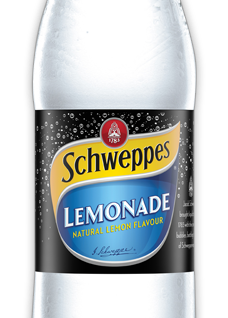
Yes, Australians make Shandies with our carbonated soft drink lemonade, though if you’re using it as a mixer, you’re less likely to be using Sprite and more likely to be using Schweppes, which looks like this:
Like. We absolutely have a concept of flat, juice-based lemonade, but as an earlier commenter said, it’s a niche hipster speciality rather than the default, and even then, it’s still going to be premade rather than fresh.
OH GOD THAT’S WHY AMERICAN CHILDREN CAN MAKE IT AND SELL IT SO EASILY. I ALWAYS WONDERED HOW KIDS COULD MAKE A CARBONATED DRINK AT HOME.
I’m surprised that no one has started calling Americans “
niche hipsters” at this point.
I love this post. It actually makes me happy that something so simple is only a thing here when so many things have become homogenized. Also amuses me that anybody outside America (I guess?) hearing “When life gives you lemons make lemonade” is thinking it means “When life gives you lemons make fucking Sprite” lmao.
I wonder what happens if you attempt to order a pink lemonade lmao.
@flippyspoon well I’m in south America (Brazil) and lemonade is juice and sprite is soda. We also use the “when life gives you lemons” saying. Now, a question I have is; pink lemonade? Does that mean the U.S has pink lemons?
Lolz you would think so but usually pink lemonade is just lemonade with food dye in it because it’s pretty but sometimes it’s sold as “strawberry lemonade” when it’s not but actual strawberry lemonade is gooood. But as a kid I could swear that pink lemonade tasted better than regular (BECAUSE IT’S PRETTY).
When you ask for pink lemonade, it’s almost always raspberry-flavored lemonade, not strawberry. (Though it was easier to find strawberry-flavored lemonade in like, the 90s.) I’m only pedantic because I was a strawberry FIEND as a kid.
While we’re talking about lemonade, no one has mentioned Country Time, the powdered drink mix you use to make “lemonade” when you’re a kid and your mom doesn’t want to buy you the lemons to show you how to make your own lemonade. I may, uh, speak from experience on that.
Also, I know the UK and Ireland has American lemonade, but they refer to it as “cloudy lemonade,” I guess because the sugar doesn’t mix up terribly well?
as someone who works in a food industry adjacent job and is going to school for it: in Germany at least, the qualification “lemonade” ( limonade) is used instead of soda. meaning under like food laws ( not the technical term, I’m tired excuse me) in Germany sprite is lemonade. coke is lemonade. dr. pepper is lemonade. that doesn’t mean I would use the word lemonade to ask for, for example coke, in a restaurant, as it’s far too vague. if I did, I’d either get sprite, fanta or if it was a fancy place, orangina maybe. probably though they’d be asking me to specify.
the only place I know for sure I’d actually get lemonade is mc donald’s! they have this lemon kiss thing right now that’s flat, has lots of crushed ice and tastes like it’s met a lemon somewhere in the production process.
if you ask for Zitronenlimonade you’ll almost certainly get sprite, that’s the name that sprite and off-brand sprite get sold under.
I wanna go back to the person who expressed disbelief about Sprite having lime in it – the logo for Sprite is literally half a lemon and half a lime.
So, going all the way back to Solo. That style of soft drink – carbonated, yellow in colour and generally more tart than lemonade – is referred to by a variety of names. “Lemon Squash” is the most sensible, but we also use the terms “club soda” and sometimes “pub squash”.
But all this brings up the question of what are Sprite, 7-Up, Lido, and the like referred to as in the US?
And do you people know the difference between ginger beer and ginger ale?
Sprite/7-up are either called by their brand names, or one is used as a catch-all (if you ask for a Sprite, the server may say “we have 7-Up,” but they’ll know what you mean), or sometimes, people will ask for “a lemon-lime soda” or “a clear soda”.
Nobody knows if Mountain Dew or Sierra Mist belong in that set, but since some restaurants have them instead of Sprite or 7-Up, they’re kind of included by default. But it’s assumed that if you want Sprite, you’ll take 7-Up, or vice versa; it is NOT assumed that Mountain Dew would also be fine.
And sure! Ginger Ale comes in a number of flavors that vary by company; it’s mostly sold in 6-packs along with other sodas, and parents will give it to small children who are sick to settle their stomachs, along with plain toast. You have to buy it in cans (or rarely, bottles) because fast-food places don’t have it.
Ginger beer comes in glass bottles with fancy labels and nobody drinks it because it costs too much.
(Lemonade: 5 lbs lemons, 2 cups sugar, 2 cups water; squeeze & strain lemons for juice, make simple syrup from sugar & water; result is concentrate that needs water to be drinkable.)
An absurdly long explanation of why I’m very iffy on “narrative bias” discussions in The Silmarillion. (Mainly relating to ones surrounding “can we trust these facts?). I’d like to thank @grundyscribbling for making me think waaaay more about this than I would’ve expected.
Disclaimer: I went easy on quotes because I hate how Tumblr is formatting them on mobile now. Seriously, @staff, please explain why that changed. I also am having a weirdly hard time putting a lot of these thoughts in words, so if it stops making sense somewhere, just ask!
Is there an “in-world” Silmarillion [1977] author?
Before we can determine if there is narrative bias, we ought to address the challenging nature of The Silmarillion’s publication. Christopher Tolkien took on the daunting task of editing his father’s work into a cohesive, publishable text. He ultimately decided “to work out a single text, selecting and arranging in such a way as seemed to me to produce the most coherent and internally self-consistent narrative” (The Book of Lost Tales, Part One).
One of the choices Christopher Tolkien made was to erase all references to an in-world author (as I’ll explain later, it would have been incredibly complicated to include). So for those who argue ‘there is nothing but the text,’ is there an in-world author? After all, there is not one in this text. For those who say ‘well, I guess not,’ congratulations, you can stop reading. (I’m jealous).
Others will point to The History of Middle-Earth and say that since the Silmarillion draws from texts attributed to in-world authors, we should assume the Silmarillion has an in-world author, too. For the moment, let’s put aside the issue of who those authors were, and instead ask if the Silmarillion is a faithful rendition of what those authors actually said?
To an extent, the answer has to be no. Christopher Tolkien drew from multiple versions in order to give us a somewhat consistent narrative. Even if a certain chapter comes from the same in-world author, it might not all come from the same version of said author. An in-world author might have had a great deal more to say on any given topic, but Christopher Tolkien, in an attempt at consistency, may have cut them off.
From here on out, I will assume that there is an in-world author, but I want to make it painfully clear that said author’s perspective has been distorted by Christopher Tolkien. (I’m not blaming him. He had an impossible job and did better than anyone could’ve possibly asked for).
Who does the Quenta Silmarillion come from?
I’m going to call the text as it exists within Arda the Quenta Silmarillion, or Q.S., to distinguish it from the book published in 1977 by George Allen & Unwin (which will be referred to as just the Silmarillion).
If one wants to discuss the Silmarillion as the sole basis for the Quenta Silmarillion, then there is simply no information on who wrote the text. It may have been one person, it may have been several. It could have been oral histories that were eventually written down by a single editor.
But adding HoME to the mix gives us more to work with. Strictly speaking, the Q.S. we see is one written down by Ælfwine. The less intrusive version is that Ælfwine was an Anglo-Saxon who, after a shipwreck, found himself on Top Eressea. There, he was taken in by a group of elves (mainly Noldor) — one of whom was Pengolodh. Pengolodh told him various histories of Arda. Ælfwine memorized these stories and later translated them into English.
If we were going to treat Tolkien’s works like strict history texts, well… We would probably be compelled to dismiss them entirely. A guy returns after years of being lost at sea, claiming to have met elves on an island no one’s ever seen (or seen since) who have him the real history of the word? But let’s skip past that obvious caveat and assume Ælfwine didn’t just have a saltwater-induced hallucination. He still isn’t a perfect translator.
First, he is doing this entirely by memory. Human memory is fallible and Ælfwine was working with a recently acquired second language. Second, it is likely that even if he was highly fluent and possessed an impeccable memory, it is possible he failed to fully understand certain terms that would’ve been necessary in a proper translation (or, if he understood them, failed to properly convey them to his human audience). What could one of those terms be? Perhaps the very concept of authorship.
Who told Ælfwine about the Quenta Silmarillion?
This one’s easy to answer! Pengolodh. Presumably, Ælfwine spoke with other elves, too, but he cites Pengolodh as his tutor in elven history and linguistics. For the sake of argument, we’ll assume no elves contradicted Pengolodh’s accounts while speaking with Ælfwine.
Did Pengolodh write the Quenta Silmarillion Ælfwine translated?
The ultimate question, isn’t it? The only honest answer is: “maybe kinda sorta?” See, various parts of the Q.S. have different attributed authors (and Tolkien wasn’t always consistent on who wrote what). For example, Rumil is often credited with writing the “first part” of what would show up in the Silmarillion, but exactly where he stopped writing is unclear. Sometimes it’s up to and including the creation of the Sun, sometimes it’s up to the Doom of the Noldor. Quennar also was involved, but again, not totally clear how. Certainly, these three Elven authors worked with each other, but the exact timeline and framework is lacking.
Children of Húrin is attributed to a human author, Dírhaval, who lived in Sirion and was killed in the Third Kinslaying. How he got his information is a bit unclear, since Tolkien attributes it to Mablung, but clearly that’s not possible in later drafts what with Mablung being dead. Other bits and pieces are still yet attributed to unnamed Sindarin scribes, others are not cited to anyone at all. None of this is to say Pengolodh wasn’t at all involved in writing: he definitely was, but how involved is a different question. But without a doubt, Pengolodh was heavily relying on other sources.
“It may be therefore that my father now regarded Pengolod as redactor or compiler rather than as author, at any rate in certain parts of the book, and in these Pengolod marked off his own contributions and named himself as authority for them” (The Lost Road and Other Writings).
When did Pengolodh write/compile the Quenta Silmarillion?
The short answer: over time. Much of his work started after the fall of Gondolin. It consistently sounds like he wrote his final drafts in Tol Eressa (where he arrived some time in the late Second Age). It seems safe to assume that the version Ælfwine saw was last edited in the Valinor. (He’s had thousands of years to check sources, rewrite, and clean things up. At some point between leaving ME and meeting Ælfwine, it makes sense that Pengolodh would have done so).
What is the Quenta Silmarillion supposed to be?
This is a question I think we don’t ask enough. The Q.S. was not supposed to be an all-encompassing history. It wasn’t even supposed to be an in-depth history of certain individuals within a certain subsection of society. It was supposed to be a brief summary, an abstract if you will, of other works, not all (or even most) of which we have access to.
“The title [‘This is the brief History of the Noldoli or Gnomes, drawn from the Book of Lost Tales’] makes it very plain that while Q was written in a finished manner, my father saw it as a compendium, a ‘brief history’ that was ‘drawn from’ a much longer work; and this aspect remained an important element in his conception of ‘The Silmarillion’ properly so called” (The War of the Jewels).
Another often-ignored question is what role history texts played in elven societies. The answer: not much.
“the lore of the Eldar did not depend on perishable records, being stored in the vast houses of their minds” (The Shibboleth of Fëanor).
General differences between elven historians and human historians:
Elves have significantly better memories (see quote above), their society is littered with telepaths and psychics, they are immortal and even those who die will presumably return one day, memories in tact. Humans die easily, permanently, and can’t remember why they walked into a room 80% of the time. These differences surely have some degree of relevance in how a historian’s bias shows up in their work.
General problems with narrative bias:
Bias is complex. Everyone has biases, but they rarely play out consistently. Often times, our biases conflict with each other. Sometimes people who might stereotypically hold a bias do not. Some people are better at pushing theirs aside (typically, this is done best by seeking out peer review). Bias is difficult to determine even if we know who the author is, and even then, it’s typically determined via post-hoc reasoning on why an author made an obvious error (or flat out lie).
Knowledge is systematic
Yeah. That. How can we determine the validity of supposed knowledge without comparing it to other knowledge? (In other words, how do we analyze the veracity of a text [i.e. Silmarillion] when there is literally nothing else to compare it to?)
Conclusion:
I am not trying to say narrative bias should be entirely thrown out in analyzing Tolkien. What I am saying is that there are so many caveats and complications in analyzing the Silmarillion that, to me, it makes very little sense to treat it the same way we would a real-world historical text, at least as it pertains to the facts contained within. If it were a real world text, we would simply not be treating it with much seriousness. Ælfwine himself presents too much of a challenge.
I don’t think we can really say who wrote the Quenta Silmarillion. We certainly don’t know how exactly they collected their information, who they spoke to, and how it’s changed since it’s original draft. I think narrative bias is best reserved for discussions about moral judgements, which, frankly, are something we should always rethinking anyhow.
In other words:
(I am also certain that people are gonna disagree. But in the interest of keeping things from spiraling into incomprehension, maybe it’d be best to respond to a single point and work there until we find common ground before moving on? IDK – just a thought. Also feel free to respond in a different post, just send me a message or something with the link since @staff has decided notifications are for the weak).
Kate Kane had specific hanukkah gelt made with the Batwoman symbol and Star of David
Batman Annual #1 – “Stag” (2017) written by Steve Orlando art by Riley Rossmo & Ivan Plascencia
I LOVE KATE SO MUCH OKAY OH MY GOSH 😀
SHE IS A GIFT ❤
the only thing that would make this better would be if they actually acknowledged that Bruce is Jewish.
He is? News to me.
I believe that he’s Jewish on his mother’s side? I’m not sure.
Yes. A flashback in Batwoman vol.02:no.25 (January 2014) confirmed the familial relationship between Kate Kane and Bruce Wayne (son of Martha Wayne, born Martha Kane) as being cousins. (Kate’s father Jacob & Bruce’s mother Martha were siblings.) Since the Kanes which Kate belongs to have been established as Jewish, and since Jewishness is matrilineal, this means Bruce Wayne is Jewish.
According to this 2005-07 article, most depictions of Batman/Bruce imply he was probably raised Catholic or Episcopalian. Even if this is the case, though, my understanding is that he’d still be considered Jewish.
It’s also established that things are… awkward, between the Kanes and the Waynes. At least back during the wonky timeline established in 2010′s The Return of Bruce Wayne (specifically, issue #5), the Kanes were convinced of the absolute worst about Thomas Wayne. The last decade or so has seen a lot of stories where accusations of terrible crimes and corruption are made against the late Waynes—as well as poor Alfred, having been their employee and close companion—and it’s often ambiguous whether or not there’s any truth to them. Especially since we’re talking about multiple writers with radically different plans for Bruce. In any case, the issue i mentioned above saw a time-lost amnesiac Bruce investigating his own parents’ murder. While he’s unknowingly speaking to his grandparents, we see this:
The cloud of insects harassing zayde Roddy and bubbe Betsy are emphatically identified as wasps, but this is Grant Morrison writing, and the cocky schmuck isn’t the type to resist a “WASPs” pun.
Fast-forwarding to the issue Doc mentions, we see that Bruce is still somewhat connected to his mother’s side of the family… but it’s only via a funeral that he seems to meet up with them.
If anything, the living Kanes seem to know Alfred better than Bruce, and their interactions with him seem fond and familiar.
Whereas we get this painfully formal and stilted “Cousin Bette” from Bruce. It seems like depressing formal functions like funerals are the only places Bruce sees any of his family.
The Kanes are distant from Bruce, and even in their more tender interactions with him, he’s linked to tragedy. A reminder of people who were lost. You’d think having had living relatives to visit with would have meant less time alone for Bruce after his parents died, but it’s made clear in that time-travel story that, even in tragedy, they aren’t comfortable having him around.
All in all, it seems a lot like Bruce is kept out of his Jewish heritage because that side of the family saw his father as something of a shegetz. Being Martha’s son means he’s in the tribe, but Thomas being his dad—and it’s often emphasized that Bruce looks so much like Thomas—means that he’s ostracized. There’s all kinds of suppositions i could make about the hows and whys, the exotified coding of Bruce as foreign in spite of his whiteness, even amidst the goyish-passing Kanes, the insularity and paranoia of Gothamites. And Bruce’s convictions about what he needs to be, what Gotham needs… well, that doesn’t help bring him in, does it?
All that said, i could write a whole huge tangent on the presentation of the Kanes as assimilated. Don’t let me ever write a real Batman story, because it’ll just be about Ashkenazic-American and Anglo-Sephardic heritage and the tensions between different Jewish ethnicities and early Tri-State Area culture clashes. Probably some stupid nods to the connection between “Gotham” as a mythical city of fools, and the Wise Men of Chelm.
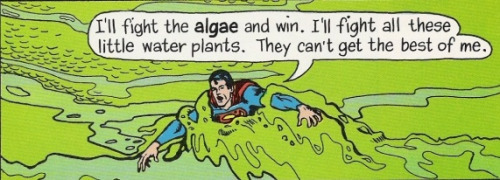
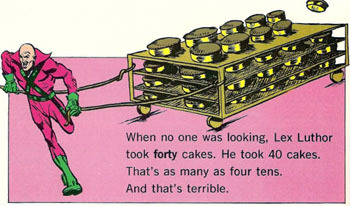
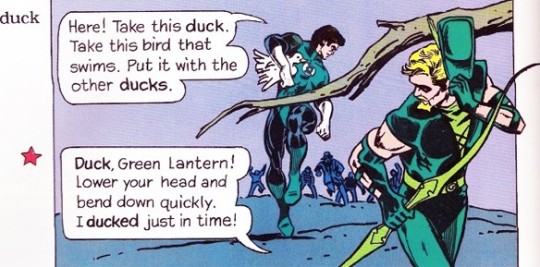
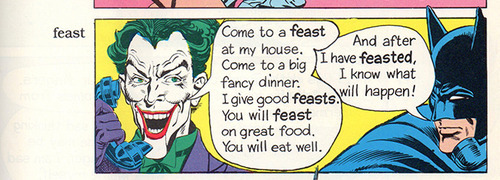
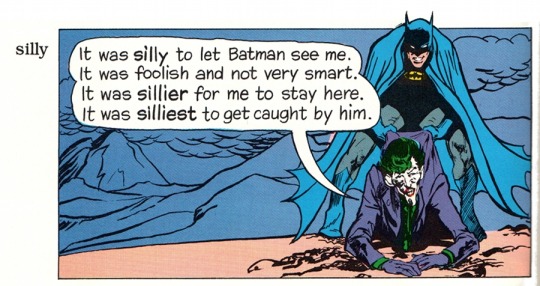
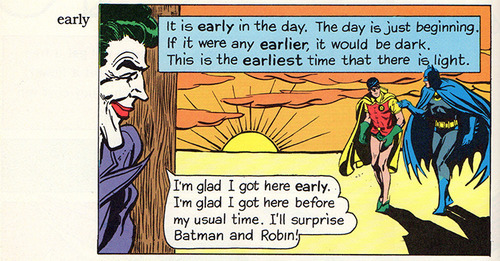
It’s in the Super Dictionary, a flawless piece of literature that has such other wonderful situations such as cake theft…
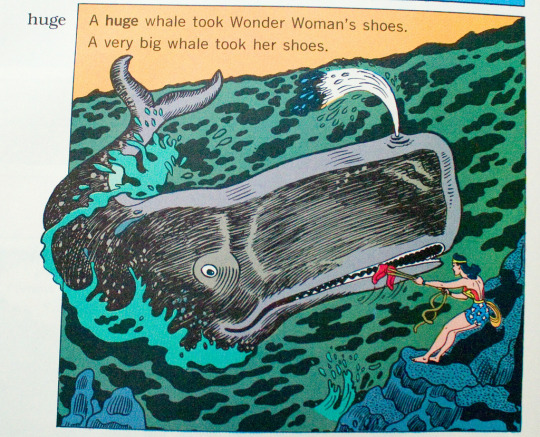
shoe-stealing whales…
Green Lantern and Green Arrow fleeing an angry mob (also a duck is involved)…
and “please help me.”
One of my greatest regrets is not owning this book.
Some more highlights from the Super Dictionary:
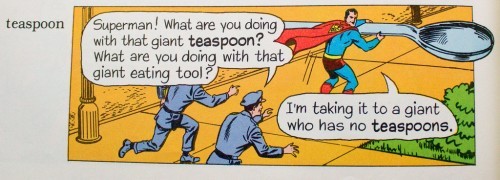
Superman is friends with a giant who has no teaspoons.
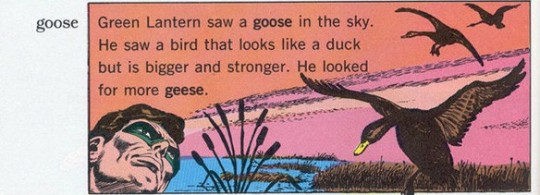
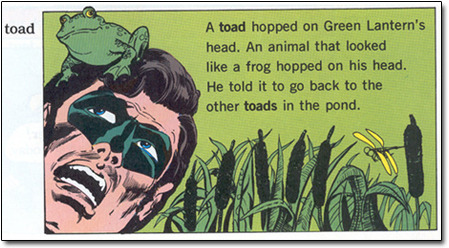
Green Lantern looks at animals.
Joker and Batman are dating.
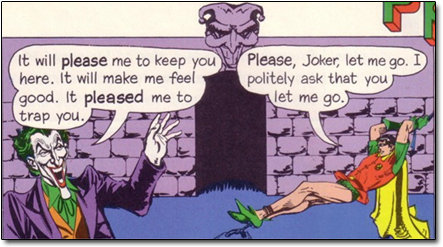
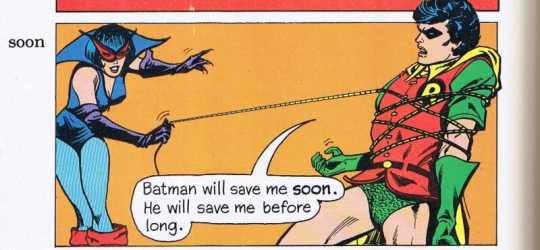
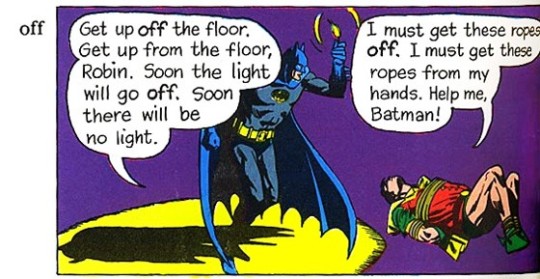
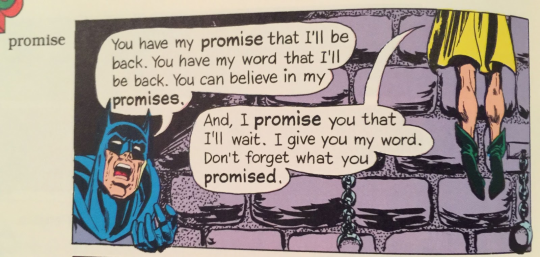
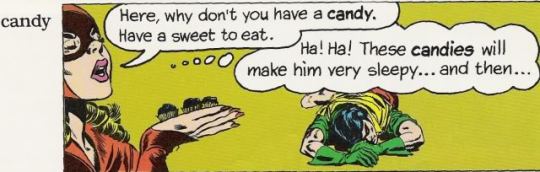
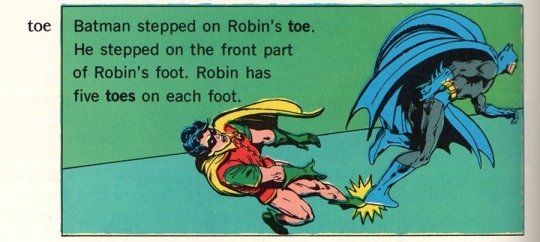
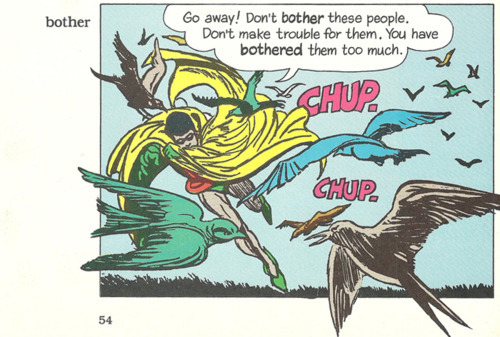
Robin gets tied up a lot.
Robin in general has a very bad time.
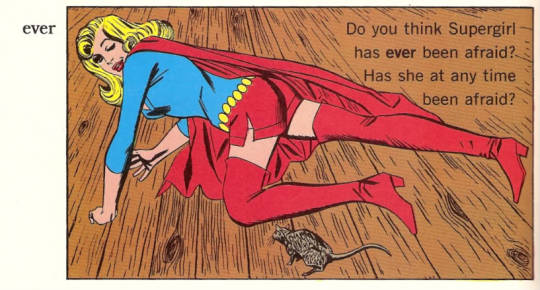
Supergirl’s text says “afraid” but her eyes say something else entirely.
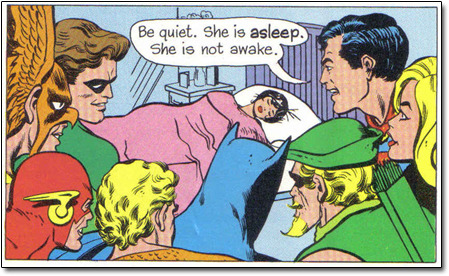
Superman invites literally everybody he knows to come and watch Lois Lane sleeping.
Lesbians.
Superman gets trapped in a bubble. Not a kryptonite bubble, just a regular soap bubble.
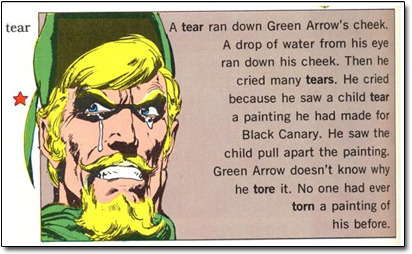
And Green Arrow plans to murder a child.
I could post dozens more of the strange situations (like Atom going on a date with a bee, Green Lantern LOSING HIS SHIT over a child trying to pick his flowers, some strange fetishy stuff with giants, Batman refusing to get down off the table, Wonder Woman’s continuous battles against pterodactyls, and Supergirl’s forays into paleontology), but that’d take forever and this post is already pretty long. The Super Dictionary is a wonderful acid trip of a book and I have never regretted purchasing my copy. If you’d like to see some scans, there’s more of them here!
The repetitive synonyms are such a good way to learn new words!! This is so cute and I love it
I inherited my brother’s copy of this as a child and my god it was one of my favourite things
I found my copy in a charity shop in London and I thank my lucky stars every time I read it.
It even made it into DC continuity. That’s a young Lex Luthor below.
… And that’s terrible.
I have never regretted buying my copy, though it is extremely difficult keeping a straight face when I read it with the grandkids 😉











 heget's WordPress